Wednesday, February 7, 2024

Jules Verne and the International Dateline

Around the World in Eighty Days ...

Most of us would have heard of or read an abridged version of Jules Verne's Around the world in 80 days in our childhood. (written in 1873)

In the story, the main protagonist, Phileas Fogg, travels eastward around the world as a challenge with his friends, that he can traverse the world in 80days and come back to his starting point. Fogg is supposed to come back to London, latest by 8:45 pm on Saturday, 21 December 1872. And meet his friends the next day.

However, the journey suffers a series of delays and when Fogg reaches London, it is 8:50 pm on Saturday, 21 December, according to him and he believes that he has lost the wager by a margin of only five minutes. The next day, however, it is revealed that the day is Saturday, not Sunday, and Fogg arrives at his club just in time to win the bet. 

Verne explains it thus:

In journeying eastward Fogg had gone towards the sun, and the days therefore diminished for him as many times four minutes as he crossed degrees in this direction. There are three hundred and sixty degrees on the circumference of the earth; and these three hundred and sixty degrees, multiplied by four minutes, gives precisely twenty-four hours - that is, the day unconsciously gained. In other words, while Phileas Fogg, going eastward, saw the sun pass the meridian eighty times, his friends in London only saw it pass the meridian seventy-nine times.

Fogg had thought it was one day later than it actually was, because he had not accounted for this fact. During his journey, he had added a full day to his clock, at the rhythm of an hour per fifteen degrees, or four minutes per degree, as Verne writes.  

It is nothing short of brilliant that Jules Verne thought about this concept and kept it as a plot point in a seemingly non Sci Fi novel.

As a child, I was really intrigued and often wondered, if all these jet setting, Globetrotting people kept adding days to their lives!

Subsequently I heard about the International Dateline - invented just to solve the above issue, but did not delve deep into the hows, whys and wheres of it.

Till recently, I read another book

The Island of the Day Before ...

The IDL is a central factor in Umberto Eco's book The Island of the Day Before (1994), in which the protagonist finds himself on a becalmed ship, with an island close at hand on the other side of the IDL. Unable to swim, the protagonist indulges in increasingly imaginative speculation regarding the physical, metaphysical and religious importance of the IDL.


This finally led me to read up on the International Dateline, and learn about it in detail. 


What is International Dateline?

Open Dictionary defines it as

An imaginary line on the Earth's surface that is internationally agreed upon as the place where each new calendar day begins. (which is rather obscure to say the least)

To elaborate -

The International Dateline is an internationally accepted demarcation on the surface of the Earth, running between the South and North Poles and serving as the boundary between one calendar day and the next. Areas to the west of the date line are one calendar day ahead of areas to the east. In other words, Crossing the date line eastbound decreases the date by one day, while crossing the date line westbound increases the date.

It is not a straight line, however. It passes through the Pacific Ocean, roughly following the 180.0° line of longitude and deviating to pass around some territories and island groups. These deviations generally accommodate the political and/or economic affiliations of the affected areas.

Why do we need it?

The 14th century Arab Geographer Abulfeda predicted that circumnavigators would accumulate a one-day offset (plus or minus) to the local date, based on his calculations and research.

This phenomenon was confirmed in 1522 at the end of the Magellan–Elcano expedition, the first successful circumnavigation. After sailing westward around the world from Spain, the expedition called at Cape Verde for provisions on Wednesday, 9 July 1522 (ship's time). However, the locals told them that it was actually Thursday, 10 July 1522. The crew was surprised, as they had recorded each day of the three-year journey without omission.

Cardinal Gasparo Contarini, the Venetian ambassador to Spain, was the first European to give a correct explanation of the discrepancy.

When?                                                          

The International Meridian Conference (1884)...

In October 1884 astronomers and representatives from 25 countries convened in Washington at the International Meridian Conference to recommend a common prime meridian for geographical and nautical charts that would be acceptable to all parties concerned. Here it was decided that, the Greenwich Meridian should be adopted as the Prime Meridian for Time zones, rather than the 180° meridian, because this mostly passed over water, making it difficult to draw/mark or define. It was decided that the 180° meridian would be retained only as a Dateline. However, no attempts were made during this conference to specify the exact course of the date line when it happened to cross land or pass through island groups.

Infact, the Conference explicitly refused to propose or agree to any time zones, stating that they were outside its purview. The conference resolved that the Universal Day, midnight-to-midnight Greenwich Mean Time (now redefined and updated as Coordinated Universal Time, or UTC), which it did agree to, "shall not interfere with the use of local or standard time where desirable". From this comes the utility and importance of UTC or "Z" ("Zulu") time: it permits a single universal reference for time that is valid for all points on the globe at the same moment.

UTC (Coordinated Universal Time) is the primary time standard globally used to regulate clocks and time. It has been widely embraced by most countries as the basis for civil time and is vital for global time synchronization, facilitating international communication, navigation, scientific research, and commerce.

Thus the term ‘International Date Line’ is in fact a misnomer. Its exact course was never defined by any international treaty, law or agreement. At the end of the 19th century, George Davidson (1825-1911), the pioneer scientist and surveyor of the American West Coast, summed up the situation as:

“There is no International Date Line. The theoretical line is 180° from Greenwich, but the line actually used is the result of agreement among the commercial steamships of the principal maritime countries.”

Based on the recommendations of the hydrographic departments of the British and the American Navy,  the date line was marked & sanctified from 1899 and 1900.

Subsequently, the following adjustments of the dateline took place

In 1900 near the island chain of Hawaii and between Samoa and the Chatham Islands, a small westward extension of the date line had been deemed necessary so that the small islands of Patrocinio and Morrell Island featured on most 19th-century nautical charts would keep the same date as Hawaii. By 1910 the non-existence of these islands had become firmly established and the date line was straightened out at that point.

Next it passed to the east of Wrangel Island and the Chukchi Peninsula, the easternmost part of Russian Siberia. This is to ensure all of Russia is to the west of the IDL, and all of the United States is to the east except for a few insular areas.

The IDL circumscribes Kiribati by swinging far to the east, almost reaching the 150°W meridian. South of Kiribati, the IDL returns westwards but remains east of 180°, passing between Samoa and American Samoa. Thus all islands on the side of Samoa including New Zealand's  Kermadec Islands fall to the west and have the same date, while American Samoa, Cook Islands and French Polynesia fall to the East and are one day behind.

The IDL then bends southwest to return to 180°. It follows that meridian until reaching Antarctica, which has multiple time zones. Conventionally, the IDL is not drawn into Antarctica on most maps. 


How does it work?

Circumnavigating the globe -

People traveling westward around the world must set their clocks:

  • Back by one hour for every 15° of longitude crossed, and
  • Forward by 24 hours upon crossing the International Date Line.

People traveling eastward must set their clocks:

  • Forward by one hour for every 15° of longitude crossed, and
  • Back by 24 hours upon crossing the International Date Line.
Otherwise their clocks will be showing one day ahead or behind the Local time.
This is to ensure that, while across the world time can vary upto 23 hrs, the date should always remain the same. 

According to the clock (UTC), the first areas to experience a new day and a New Year are islands that use UTC+14:00. These include portions of the Republic of Kiribati, including Millennium Island in the Line Islands. The first major cities to experience a new day are Auckland and Wellington, New Zealand (UTC+12:00; UTC+13:00 with daylight saving time).

A 1994 realignment of the IDL made Caroline Island one of the first points of land on Earth to reach January 1, 2000, on the calendar (UTC+14:00). As a result, this atoll was renamed Millennium Island

Two U.S.-owned uninhabited atolls, Howland Island and Baker Island, just north of the equator in the central Pacific Ocean, have the earliest time on Earth (UTC−12:00 hours).

The areas that are the first to see the daylight of a new day vary by the season. Around the June solstice, the first area would be any place within the Kamchatka Time Zone (UTC+12:00) that is far enough north to experience midnight sun on the given date. 

At the equinoxes, the first place to see daylight would be the uninhabited Millennium Island in Kiribati, which is the easternmost land located west of the IDL.

Near the December solstice, the first places would be Antarctic research stations using New Zealand Time (UTC+13:00) during summer that experience midnight sun. These include Amundsen-Scott South Pole Station, McMurdo Station, Scott Base and Zucchelli Station.

De facto and de jure date lines...

There are two ways time zones and thereby the location of the International Date Line are determined, one on land and adjacent territorial waters, and the other on open seas.

All nations unilaterally determine their standard time zones, applicable only on land and adjacent territorial waters. This date line can be called de facto since it is not based on international law, but on national laws. These national zones do not extend into international waters.

The nautical date line, not the same as the IDL, is a de jure construction determined by international agreement. It is the result of the 1917 Anglo-French Conference on Time-keeping at Sea, which recommended that all ships, both military and civilian, adopt hourly standard time zones on the high seas. The United States adopted its recommendation for U.S. military and merchant marine ships in 1920. This date line is implied but not explicitly drawn on time zone maps. It follows the 180° meridian except where it is interrupted by territorial waters adjacent to land, forming gaps—it is a pole-to-pole dashed line. The 15° gore that is offset from UTC by 12 hours is bisected by the nautical date line into two 7.5° gores that differ from UTC by ±12 hours.

In theory, ships are supposed to adopt the standard time of a country if they are within its territorial waters within 12 nautical miles (14 mi; 22 km) of land, then revert to international time zones (15° wide pole-to-pole gores) as soon as they leave. In practice, ships use these time zones only for radio communication and similar purposes. For internal (within-ship) purposes, such as work and meal hours, ships use a time zone of their own choosing.

Cartographic practice...

The IDL on all maps is based on the de facto line and is an artificial construct of cartographers, as the precise course of the line in international waters is arbitrary. The IDL does not extend into Antarctica on the world time zone maps.  

The IDL on modern CIA (United States Central Intelligence Agency) maps reflects the most recent shifts in the IDL. 

On the other hand the HMNAO (United Kingdom's His Majesty's Nautical Almanac Office) maps do not draw the IDL in conformity with recent shifts in the IDL; they are drawn virtually identical to the line adopted by the UK's Hydrographic Office about 1900. However, HMNAO labels Island groups with their time zones, thus keeping them updated with National and Nautical Time Zones.

In fact, the islands of eastern Kiribati are actually "islands" of Asian date (west side of IDL) in a sea of American date (east side of IDL). Similarly, the western Aleutian Islands are islands of American date in a sea of Asian date.

No international organization, nor any treaty between nations, has fixed the IDL drawn by cartographers.

Issues with Religion...

Generally, the Christian calendar and Christian churches recognize the IDL. Christmas for example, is celebrated on 25 December as that date falls in countries located on either side of the IDL. Thus, Christians in Samoa, immediately west of the IDL, will celebrate the holiday a day before Christians in American Samoa, which is immediately east of the IDL.

However a problem arises when a day & not a date is observed. Like the Sabbath on Saturday. Because, notwithstanding the difference in dates, the same sunrise happens over American Samoa as happens over Samoa a few minutes later, and the same sunset happens over Samoa as happens over American Samoa a few minutes earlier. In other words, the secular days are legally different but they are physically the same; and that causes questions to arise under religious law. Because the IDL is an arbitrary imposition, the question can arise as to which Saturday on either side of the IDL (or, more fundamentally, on either side of 180 degrees longitude) is the "real" Saturday. This issue (which also arises in Judaism) is a particular problem for Seventh Day Adventists, Seventh Day Baptists, and similar churches located in countries near the IDL. Many countries observe Sabbath on part Fridays and part Sundays too, because of this.

The Islamic calendar and Muslim communities recognize the convention of the IDL. In particular, the day for holding the Jumu'ah prayer appears to be local Friday everywhere in the world. The IDL is not a factor in the start and end of Islamic lunar months. These depend solely on sighting the new crescent moon. The fasts of the month of Ramadan begin the morning after the crescent is sighted. That this day may vary in different parts of the world is well known in Islam.

The concept of an International Date Line in Jewish law is first mentioned by 12th-century decisors. But it was not until the introduction of improved transportation and communications systems in the 20th century that the question of an International Date Line truly became a question of practical Jewish law. However, now the IDL is taken as a de facto line by Jews, the world over, who observe Shabbath on local Saturday.

IDL Crossing Ceremonies...

Ceremonies aboard ships to mark a sailor's or passenger's first crossing of the Equator, as well as crossing the International Date Line, have been long-held traditions in navies and in other maritime services around the world.


Line-crossing ceremony aboard 
Méduse on the first of July 1816.

When Jules Verne wrote his book, the concept of a de jure International Date Line did not exist. Yet it was his sheer genius coming up with a story like that, that could stir the imagination of so many children and adults alike.

In today's world, if Phileas Fogg travelled across the globe, once he reached the IDL, he would have readjusted his clock/ calendar. Thus, the day he would add to his clock through his journey would get automatically removed upon crossing this imaginary line.

However, this pragmatic solution is rather anticlimactic for my imaginative premise of the Rich and the Famous adding endless days to their lives!


Tuesday, February 6, 2024

Bhuvaneshwaris and their fore runners ...

Bhuvanewaris is the term used to refer to the ornate & intricate domed ceilings found in Hoysala temples.

I first set eyes on a Bhuvaneswari, during our Site Seminar 2023. Needless to say, my eyes just popped out. Such was the precision, detailing and amazing creativity executed to perfection, that one just couldn't have enough of it. All my earlier criticism of lack of proportions in Hoysala temples or lack of grace in their sculptures vanished into thin air.

Anybody who could execute this knew everything about architecture, structure, art, craft, detailing & execution; not to mention a perfect understanding of the medium involved -  the Chlorite Schist stone.  I was so fascinated with their variety & beauty, that I must have clicked at least 100pics of Bhuvaneshwaris alone in the various temples we visited.

A few Beautiful Bhuvaneshwaris


Typically though, when we came back, I catalogued my pics & forgot all about them.

Till in December 2023, THT had their Pechu Kacheri on Hoysala Art and Architecture & Gopu asked me, if I could prepare a 7 minute presentation on the Bhuvaneswaris. He further set me thinking, by asking, if we had Domes in India before this and what were they called?

I spent the next 10 days, happily reading up, researching (to some extent) and conjecturing (to a large extent) on Bhuvaneswaris, their origin, evolution, detailing and the unanswered mysteries about them.

Infact my presentation was called -  புவனேஸ்வரி ஒரு கேள்விக்குறி ? (An oblique reference to a popular Tamizh movie)


A few things I discovered...

What are Structural Domes?

A Structural Dome is a specific Architectural element (similar to the hollow upper half of a sphere) executed to roof a large column free space.

A dome can rest directly upon a rotunda wall, a drum, or a system of squinches or pendentives used to accommodate the transition in shape from a rectangular or square space to the round or polygonal base of the dome. The dome's apex may be closed or may be open in the form of an oculus, which may itself be covered with a roof lantern and cupola

Although earliest Domes have a long architectural lineage that extends back into prehistory, they became predominant with the advent of Islam and evolution of Persian Architecture. Since Islam is a religion based on congregational prayer, large column free halls was a necessity. To answer this Domes were developed. Extending into Byzantine and Sasanian architecture, they were soon borrowed by Rome. Through Middle Ages and Renaissance, they spread across Europe and the entire west, acquiring a parallel language for Christianity.

In India they arrived with the Muslims.

The Alai Dawarza, a gate in the Qutb complex built in 1311, has the first dome in India made of finely dressed stone cut into voussoir blocks. 


However Hoysalas built their Domes as early as 11th Century which led me to conclude that
  • Bhuvanewaris were Indigenous innovations built using a corbelling or stepping technique.
  • Pioneered by the Hoysalas - to suit their own needs of a Decorative ceiling which is more interesting than a mere flat roof.
The above surmise is based on the facts that 
The Navarangas (ForeCourts) over which Bhuvaneswaris are built, normally have a row of Columns in both directions. Central 4 columns are chosen over which the Dome is built. This area could have easily had a flat roof as well. Thus it is the need to have a differential ceiling surface, to decorate - which has propelled their execution.


Further Bhuvaneshwaris are hardly visible from outside. There is no triumph of Structural achievement here, nor any attempt to integrate them with the overall temple in terms of proportions or architectural equations. It is the Interior which is prominent here.


Thus in my ignorance, I concluded Bhuvaneswaris to be a unique, original, innovative phenomenon discovered by the Hoysalas, not repeated either before or after.

Till we came to Site Seminar 2024 and had our preparatory lecture by none other than the great scholar Ms. Kumud Kanitkar. First she spoke about the Ambernath temple at Mumbai and then about the Bhuleshwar temple at Pune. She used a hitherto unheard term - the Karotaka Ceiling.

This sent me googling again. Without much result. All that I could gather -
Similar to Bhuvaneshwaris (though far less ornate) Karotaka ceilings have been there in temples of Maharashtra & Gujarat. Built around the same time (11th Century CE), the major difference seems to be
  • There is no Exterior dome.
  • Inside the hollow of the Corbelled Shikara, a dome has been fitted.
  • In all probabilty, this dome was made in parts at ground level as sections (similar to petals) and assembled at the ceiling level.
  • Thus Karotaka too has no structural purpose and is purely an Interior element meant to enhance the internal visual appearance alone


When we actually visited Ambernath and Bhuleshwar, though the temples were magnificent with beautiful sculptures - the Kharotakas were a disappointment. Not so well maintained, nor so ornate. Nothing breath taking here. They only served to prove that the Bhuvaneshwaris may not have been completely original, nor pioneering attempts at constructing Interior domes, at floor level and then assembling them at the Ceiling level.


There are, perhaps, similar Domed Ceilings elsewhere in other temples too leading one to wonder - How was it possible that across such a large country (with minimal transport and Communication facilities in those days), we have a similar idiom or language for temple building across the entire expanse - from North to South and East to West?
(Avantipura in Kashmir has a similar plan to Kailasanatha in Kanchipuram).

To quote Adam Hardy -
A symbolic function resides in the temple form. Just as the temple exterior was designed to create a skyward surge visually, the same was the desired effect internally, with intricate ceilings drawing the devotee's eyes upward towards the Manifest and then the Absolute.
It is this basic concept, that perhaps unifies all our temples, even amidst their variations in form, material and the Gods they house.

My own question demanding an answer -
Why is it that all of us know so much about Michelangelo's Sistine Chapel - Marvel about it, study it in detail and discuss and debate on it endlessly - yet know next to nothing about our own beautiful temple ceilings - equally or more difficult to execute, intricate and beautiful in their art, craft and mathematical precision? 
When, if at all, are we going to acknowledge our Art and Artisans?

On that note, let me conclude, with a picture of one of the most beautiful Bhuvaneshwaris 


Sunday, September 24, 2023

Did Man walk on the Moon?

As recently as yesterday, that too after attending a technical talk on the Chandrayans, somebody raised a doubt, about whether The Apollo Missions were true or fakes? Someone else clarified that such information has to be accepted mostly on FAITH only.

This led me to read up, once again, on the Apollo Missions, the facts as they stand, the conspiracy theories surrounding these missions and the counter arguments. 

First the Facts as presented…

First Landing of Man on the Moon – Apollo 11

The primary objective of Apollo 11 was to complete a national goal set by President John F. Kennedy on May 25, 1961: perform a crewed lunar landing and return to Earth.

Additional flight objectives included scientific exploration by the lunar module (LM) crew; deployment of a television camera to transmit signals to Earth; and deployment of a solar wind composition experiment, seismic experiment package and a Laser Ranging Retroreflector. 

During the exploration, the two astronauts were to gather samples of lunar-surface materials for return to Earth. They also were to extensively photograph the lunar terrain, the deployed scientific equipment, the LM spacecraft, and each other, both with still and motion picture cameras. 

This was to be the last Apollo mission to fly a "free-return" trajectory, which would enable a return to Earth with no engine firing, providing a ready abort of the mission at any time prior to lunar orbit insertion.

Apollo 11 launched from Cape Kennedy on July 16, 1969, carrying Commander Neil Armstrong, Command Module Pilot Michael Collins and Lunar Module Pilot Edwin "Buzz" Aldrin into an initial Earth-orbit of 114 by 116 miles. An estimated 650 million people watched Armstrong's televised image and heard his voice describe the event as he took "...one small step for a man, one giant leap for mankind" on July 20, 1969.


The Mission was made up of a command and service module, or CSM, Columbia, piloted by Collins which included the spacecraft-lunar module adapter, or SLA, containing the lunar module, or LM, Eagle.

The first EVA began when Armstrong emerged from the Eagle and deployed the TV camera for the transmission of the event to Earth. At about 109 hours, 42 minutes after launch, Armstrong stepped onto the moon. About 20 minutes later, Aldrin followed him. The camera was then positioned on a tripod about 30 feet from the LM. Half an hour later, President Nixon spoke by telephone link with the astronauts.

Commemorative medallions bearing the names of the three Apollo 1 astronauts who lost their lives in a launch pad fire, and two cosmonauts who also died in accidents, were left on the moon's surface. A one-and-a-half inch silicon disk, containing micro miniaturized goodwill messages from 73 countries, and the names of congressional and NASA leaders, also stayed behind.

During the EVA, in which they both ranged up to 300 feet from the Eagle, Aldrin deployed the Early Apollo Scientific Experiments Package (EASEP) and Armstrong and Aldrin gathered and verbally reported on the lunar surface samples. After Aldrin had spent one hour, 33 minutes on the surface, he re-entered the LM, followed 41 minutes later by Armstrong. The entire EVA phase lasted more than two-and-a-half hours, ending at 111 hours, 39 minutes into the mission.

Armstrong and Aldrin spent 21 hours, 36 minutes on the moon's surface. 

EVA refers to Extravehicular activity - Any activity done by an astronaut in outer space outside a spacecraft.

Trans-Earth injection of the CSM began on July 21. Two Television Transmissions each were made during the trans-moon and trans-earth courses. 

Re-entry procedures were initiated on July 24, 44 hours after leaving lunar orbit. The SM separated from the CM, which was re-oriented to a heat-shield-forward position. Parachute deployment occurred and after a flight of 195 hours, 18 minutes, 35 seconds - about 36 minutes longer than planned - Apollo 11 splashed down in the Pacific Ocean, 13 miles from the recovery ship USS Hornet on July 24, 1969.


Subsequent Apollo Missions carrying Men – Apollo 12–17

Apollo 11 was followed by six further trips to the Moon, five of which landed successfully. 12 men walked on the lunar surface in total. But in 1970 future Apollo missions were cancelled. Apollo 17 became the last crewed mission to the Moon, for an indefinite amount of time. Taking place between 7 and 19 December 1972, it was a 12-day mission and broke many records, the longest space walk, the longest lunar landing and the largest lunar samples brought back to Earth. 

Harrison H. Schmitt was the lunar module pilot, as well as being a geologist. He was joined by Ronald E. Evans as command module pilot and Eugene Cernan as Mission Commander. 

Apollo 17 was the only Apollo mission to not carry any astronauts who had previously been test pilots. After the cancellation of Apollo 18, the Apollo mission Schmitt had originally intended to go on, the scientific community lobbied that he be put onto Apollo 17. 

Scientist-astronaut Harrison H. Schmitt, Apollo 17 lunar module pilot, collects lunar rake samples at Station 1 during the mission's first spacewalk at the Taurus-Littrow landing site (NASA)

Cernan was the last to leave the lunar surface, and therefore is the most recent person to stand on the Moon. As he ascended to the lunar module he said:

 ".. I'm on the surface; and, as I take man's last step from the surface, back home for some time to come - but we believe not too long into the future - I'd like to just [say] what I believe history will record. That America's challenge of today has forged man's destiny of tomorrow. And, as we leave the Moon at Taurus-Littrow, we leave as we came and, God willing, as we shall return, with peace and hope for all mankind. Godspeed the crew of Apollo 17."

At that time, it was known that no further crewed missions will be sent to moon for sometime.


Beginning of the Fake Controversy

It took 400,000 Nasa employees and contractors to put Neil Armstrong and Buzz Aldrin on the moon in 1969 – but only one man to spread the idea that it was all a hoax. His name was Bill Kaysing.

Kaysing said it started as “a hunch, an intuition”, before turning into “a true conviction” – that the US lacked the technical prowess to make it to the moon (or, at least, to the moon and back). Kaysing had actually contributed to the US space programme. Between 1956 and 1963, he was an employee of Rocketdyne, a company that helped to design the Saturn V rocket engines. In 1976, he self-published a pamphlet called 'We Never Went to the Moon: America’s Thirty Billion Dollar Swindle', which sought evidence for his conviction by means of grainy photocopies and various theories. He managed to establish a few perennial doubts, that are kept alive to this day in Hollywood movies and Fox News documentaries, Reddit forums and YouTube channels.

Despite the extraordinary volume of evidence (including 382kg of moon rock collected across six missions; corroboration from Russia, Japan and China; and images from the Nasa Lunar Reconnaissance Orbiter showing the tracks made by the astronauts in the moon dust), belief in the moon-hoax conspiracy has blossomed since 1969. 

According to Guardian - Among 9/11 truthers, anti-vaxxers, chemtrailers, flat-Earthers, Holocaust deniers and Sandy Hook conspiracists, the idea that the moon landings were faked isn’t even a source of anger any more – it is just a given fact.

Until his death in 2005, Kaysing maintained that the whole thing was a fraud, filmed in a TV studio. “It’s well documented that Nasa was often badly managed and had poor quality control,” he told Wired in 1994. “But as of 1969, we could suddenly perform manned flight upon manned flight? With complete success? It’s just against all statistical odds.”

In a way, he was right. When the Soviets launched Sputnik 1 in October 1957 (followed one month later by Sputnik 2, containing Laika the dog), the US space programme was all but non-existent. Nasa was founded in 1958 and managed to launch Alan Shepard into space in May 1961 – but when John F Kennedy announced that the US “should commit itself to achieve the goal, before this decade is out, of landing a man on the moon and returning him safely to the Earth”, it seemed a stretch. By the mid-60s, Nasa was consuming more than 4% of the US federal budget, but while the Soviets were achieving more firsts – the first woman in space (1963), the first extra-vehicular activity, ie spacewalk (1965) – the Americans experienced various setbacks, including a launchpad fire that killed all three Apollo 1 astronauts.

This, however, can not be the basis for doubting a mission (a series of missions), witnessed by people all over the world, analysed, vetted and endorsed by an entire community of scientists, technocrats and astronauts from all over the world.

The supposed Anomalies and counter Arguments

The moon-hoax theory entered the modern era in 2001, when Fox News broadcast a documentary called Did We Land on the Moon? Hosted by the X-Files actor Mitch Pileggi, it repackaged Kaysing’s arguments for a new audience. So widespread was its popularity, that parents and school teachers started asking NASA for their version of justifications.


The 4 major questions/ theories proposed by Kaysing and developed further by others include

 The waving flag

Conspiracy theorists say:

In the footage, the US flag that Neil Armstrong and Buzz Aldrin rammed into the moon's regolith blows in the wind. But that is not possible, because there is no atmosphere on the moon.


Science says:

The flag did not flap. It only moved when the two astronauts touched it and rammed it into the ground. On Earth, the atmosphere quickly slows down such light oscillations. But on the moon - without atmosphere - the oscillations keep going for much longer. In addition, a cross strut was braced in the flag to give the impression it was blowing.


 No stars in the Photos

Conspiracy theorists say:

On the moon pictures, no stars are to be seen. So they were created in a studio.


Science says:

It's true that on the moon — without an atmosphere to disturb things — one should have a fantastic view of the starry cosmos. But when the astronauts were on the moon, it was always daytime. In fact the moon's surface, the lander and the astronauts were so brightly illuminated by the sun that the weak light of the stars would be impossible to be seen.


        The Photos were too perfect

Conspiracy theorists say:

The Hasselblad cameras carried by the astronauts at chest height had no viewfinder. How could the astronauts take so many perfect photos with them?


Science says:

Not all pictures were perfect. There are numerous blurred images in NASA's archives. Only the most beautiful ones have been published. In addition, the astronauts had time to practice with the Hasselblad cameras on Earth. A special wide-angle lens simplified focusing and allowed larger image sections.


        The shadows run diagonally

Conspiracy theorists say:

Some photos show shadows that do not run parallel to each other. With the sun as the only light source, however, all shadows should run in parallel. But they don't. That's why spotlights must have been involved.


Science says:

Parallelism is always a matter of perspective. Parallel lines on a three-dimensional surface always appear as if they are converging if they are imaged two-dimensionally. Think of railway tracks. They seem to converge towards the horizon, although they are always guaranteed to be parallel. This is true on earth and also on the moon. 


Fried by Radiation

Perhaps the most convincing argument that the landings were faked has to do with something called the Van Allen belts. These are two giant doughnut-shaped belts surrounding the Earth. They are made of highly energetic charged particles from the solar wind. Some people believe humans couldn’t have passed through these belts without being exposed to lethal doses of radiation.

This was a genuine concern before the Apollo missions. And it is the reason scientists behind Apollo 11 made sure they protected the astronauts as best they could. They insulated the spacecraft from radiation with an Aluminium shell. And they chose a trajectory from the Earth to the Moon which minimised the amount of time spent in the Van Allen belts.

Readings from the nine Apollo missions that reached the Moon showed the astronauts’ average radiation exposure was 0.46 radiation-absorbed dose (rad). This proved Nasa was right to shield the astronauts from radiation. Though it’s less than that experienced by some nuclear energy workers, 0.46 rad is around 10 times more than the radiation exposure of medical professionals who routinely work with x-ray and radiotherapy machines.

However the Moon fact is very clear. As of today, even with a powerful amateur telescope you can see the Apollo landing sites and, if you look at the photos from the Lunar Reconnaissance Orbiter, you can spot the remnants of the Apollo missions yourself.


In Conclusion

Of course, until we return to the Moon there will always be anomalies and oddities in the records that can spark new claims that the Moon landings were faked. But it is the sheer size and variety of this record that proves every one of these claims to be false.

From the Apollo Moon missions, there are 8,400 publicly available photos, thousands of hours of video footage, a mountain of scientific data, and full transcripts and audio recordings of all air-to-ground conversations. We even have 382 kilograms of Moon rock that Apollo astronauts brought back to Earth. These rocks have been independently verified as lunar by laboratories around the world, ruling out a US conspiracy.

If this is not enough,, Nasa’s Lunar Reconnaissance Orbiter (LRO) takes high resolution pictures of the lunar surface from a low orbit, even today. During its mission, it has captured the landing sites and the abandoned descent modules and rovers from the Apollo missions. And its resolution is so good it has picked up the dark squiggly paths that the astronaut’s footprints made. Spacecrafts from China, India and Japan have also spotted these landing sites, providing further independent verification of the landings.

Apart from all the above, is a simple instrument installed 54 years ago by Apollo 11. During their day on the Moon, Armstrong and Aldrin planted a lunar laser ranging retroreflector array on the surface. It’s still operational today, and allows us to reflect lasers off of it and measure the distance to the Moon down to the centimetre. We simply couldn’t do this if we hadn’t visited the Moon.

In Armstrong’s own words – If walking around on the surface of the moon was difficult (inspite of the TV cables wrapped around his feet), then correcting course and landing on the moon was ten times tougher -“far and away the most complex part of the flight. And we were not sure if we were ready for it till it happened".

That is until you compare it with the difficulty of maintaining a lie to the entire world for five decades without a single slip from any Nasa employee. You would also have to imagine that 2019-era special effects were available to Nasa in 1969 and not one of the 600 million TV viewers noticed anything amiss. Stanley Kubrick’s 2001: A Space Odyssey (1968) is a decent indication of what Hollywood special effects could do at the time – and it’s extremely tacky. It genuinely was simpler to film on location.

Lastly in a homage to science and its achievements it is only fair to believe that that the 12 astronauts in total who have walked on the Moon and the 400,000 people involved in the Apollo programme would have neither the will nor the way to fake one of humanity’s greatest ever achievements.


https://www.nasa.gov/mission_pages/LRO/news/apollo-sites.html
The above link also offers latest evidence lending absolute credence to the Apollo Missions.


References :

·   One giant … lie? Why so many people still think the moon landings were faked - The Guardian

·   How do we know that we went to the Moon? – Institute of Physics

·   Did the Moon landing actually happen? – Made for Minds

·   Wikepedia and other sites


Saturday, September 16, 2023

Why QWERTY? Why not ABCD?

As a two finger typist, I have often wondered about what could have been the rationale behind the QWERTY key board.

For the uninitiated lot, 

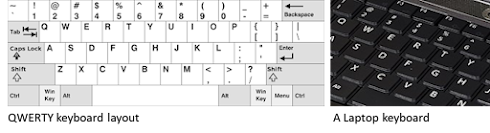
QWERTY is a keyboard layout for Latin-script alphabets. The name comes from the order of the first six keys on the top left letter row of the keyboard (Q W E R T Y). The QWERTY design is based on a layout created for the Sholes and Glidden typewriter and sold to E. Remington and Sons in 1873. It became popular with the success of the Remington No. 2 of 1878, and remains in ubiquitous use.


Who came first/ The Typist or the Keyboard?

As I was looking for the logic behind the design, a natural question came to my mind. Did the Typist decide the ultimate keyboard design or the other way round?

Surprisingly there are 2 theories regarding the History of Evolution of the keyboard design, each supporting a different option. 

However there is no dispute regarding who invented this keyboard and when? The options are only for Why?

History of the QWERTY Keyboard

QWERTY layout was developed along with, and inextricably linked to, early typewriters.

In the 1860s, a politician, printer, newspaper man, and amateur inventor in Milwaukee by the name of Christopher Latham Sholes spent his free time developing various machines to make his businesses more efficient. One such invention was an early typewriter, which he developed with Samuel W. Soulé, James Densmore, and Carlos Glidden, and first patented in 1868. The earliest typewriter keyboard resembled a piano and was built with an alphabetical arrangement of 28 keys. The team surely assumed it would be the most efficient arrangement. After all, anyone who used the keyboard would know immediately where to find each letter; hunting would be reduced, pecking would be increased. 

Experimental Sholes & Glidden typewriters circa 1873 The World of Typewriters


In 1873, Sholes after redesigning and re patenting his keyboard several times, arrived at the QWERTY. Then, along with his cohorts, he entered into a manufacturing agreement with gun-maker Remington, a well-equipped company familiar with producing precision machinery and, in the wake of the Civil War, looking for new business.  The deal with Remington proved to be an enormous success. By 1890, there were more than 100,000 QWERTY-based Remington produced typewriters in use across the country. 

The fate of the keyboard was further sealed in 1893 when the five largest typewriter manufacturers –Remington, Caligraph, Yost, Densmore, and Smith-Premier– merged to form the Union Typewriter Company and agreed to adopt QWERTY as the de facto standard that we know and love today.

Further Remington’s pre-merger business tactics ensured lifelong popularity for QWERTY. Remington didn’t just produce typewriters, they also provided training courses – for a small fee, of course. Typists who learned on their proprietary system would have to stay loyal to the brand, so companies that wanted to hire trained typists had to stock their desks with Remington typewriters. It’s a system that still works today, as illustrated by the Apple Ecosystem.

Thus QWERTY came to be.


U.S. Patent No. 207,559. The first appearance of the QWERTY keyboard. Google patents


Now to the question of the 

Logic behind QWERTY

Option 1 - The Typewriter/Keyboard decided its fate (Machine came before Man)

The popular theory states that Sholes had to redesign the early keyboard in response to the mechanical failings of early typewriters, which were slightly different from the models most often seen in antique stores and museums today. The type bars connecting the key and the letter plate hung in a cycle beneath the paper. If a user quickly typed a succession of letters whose type bars were near each other, the delicate machinery would get jammed. So, it is said, Sholes redesigned the arrangement to separate the most common sequences of letters like “th” or “he”. In theory then, the QWERTY system should maximize the separation of common letter pairings. This theory could be easily debunked for the simple reason that “er” is the fourth most common letter pairing in the English language. 

By 1873, the typewriter had 43 keys and a decidedly counter-intuitive arrangement of letters that supposedly helped ensure the expensive machines wouldn’t break down. Form follows function and the keyboard trains the typist. 

Option 2 - The Typist dictates the Design (Man decided the fate of the Machine)

The development of QWERTY design as a response to mechanical error, has been questioned by Kyoto University Researchers Koichi Yasuoka and Motoko Yasuoka. In a 2011 paper, the researchers tracked the evolution of the typewriter keyboard alongside a record of its early professional users. They conclude that the mechanics of the typewriter did not influence the keyboard design. Rather, the QWERTY system emerged as a result of how the first typewriters were being used. Early adopters and beta-testers included telegraph operators who needed to quickly transcribe messages. However, the operators found the alphabetical arrangement to be confusing and inefficient for translating morse code. The Kyoto paper suggests that the typewriter keyboard evolved over several years as a direct result of input provided by these telegraph operators. 

The Kyoto paper also cites the Morse lineage to further debunk the theory that Sholes wanted to protect his machine from jamming by rearranging the keys with the specific intent to slow down typists:

The speed of Morse receiver should be equal to the Morse sender, of course. If Sholes really arranged the keyboard to slow down the operator, the operator became unable to catch up the Morse sender. We don’t believe that Sholes had such a nonsense intention during his development of Type-Writer.”

In this scenario, the typist came before the keyboard. 

Sholes Further Developments

Regardless of how he developed it, Sholes himself wasn’t convinced that QWERTY was the best system. Although he sold his designs to Remington early on, he continued to invent improvements and alternatives to the typewriter for the rest of his life, including several keyboard layouts that he determined to be more efficient, such as the following patent, filed by Sholes in 1889, a year before he died, and issued posthumously.


U.S. Patent No. 568,630, issued to C.L. Sholes after his death Google patents


Why QWERTY continued in the Computer era?

I was then obviously wondering, why this rather cumbersome design continued into the Era of Computers. Computers never got jammed.

But the reason is obvious. Millions of people had learned to type on the QWERTY keyboards. It had become truly ubiquitous in countries that used the Latin alphabet. 

Also, Teletype, the company that produced electronic typewriters and computer terminals widely used around the world, in the beginning, had adopted QWERTY, thereby ensuring its place as the new technological standard.

Competitors for QWERTY

Although, from time to time, there were competitors for QWERTY, the noteworthy ones are

Dvorak Simplified Keyboard

Developed by Dr. August Dvorak in the 1930s, Dvorak users reported faster and more accurate typing, in part because the system dramatically increases the number of words that can be typed using the “home” row of keys where your fingers naturally rest – also known as the keys you type when you’re just trying fill space. asjdfkal; sdfjkl; asdfjkl; asdfjkl; dkadsf. asdfjklasdfjk. 

But even in 1930 it was already too late for a new system to gain a foothold. While Dvorak certainly has its champions, it never gained enough of a following to overthrow King QWERTY. After all, the world learned to type using Remington’s keyboard.


Dvorak simplified Keyboard

KALQ  Keyboard

When a design depends on a previous innovation too entrenched in the cultural zeitgeist to change, it’s known as a path dependencyThe new KALQ keyboard attempts to break from the tyranny of Christopher Latham Sholes, whose QWERTY system makes even less sense on the virtual keyboards of tablets and smartphones than it does on a computer keyboards. 

It has been designed around a very specific, very modern behavior – typing with thumbs. Like the telegraph operator QWERTY theory, the user is determining the structure of the keyboard. 

The KALQ keyboard (dubbed after the order the keys appear in the keyboard, analogous to QWERTY) is a keyboard layout that has been developed by researchers at the Montana Tech, University of St Andrews and the Max Planck Institute for Informatics as a split-screen keyboard for thumb-typing, which is claimed to allow a 34% increase in speed of typing for the people who use touchscreen. KALQ was released as a free app, albeit a beta, for Android-based smartphones. Although the KALQ project received some buzz in tech media, as of early 2017, the latest public version is dated October 2013, and still labelled a beta.

KALQ - For Thumb typing

In Conclusion....

Almost any system that has been developed wrt to Keyboard design (including the KALQ) , seems to be a product of path dependency. Because no matter how the letters are arranged, the basic notion of individually separated letters distributed across a grid dates back to Sholes and co. tinkering away in their Milwaukee workshops. Which does not meet any requirements of a tablet or Smartphone.

Which leads one to 2 more questions

  • Is it at all possible to have a faster, more intuitive, more user friendly keyboard design? Would we have to start from scratch then? Preferably someone who has never used a keyboard to minimise influences?
  • Why is our cutting edge technology, developing in leaps and bounds, still basing its design of a core Input component on something that dates more than 150 years ago, when design was a different ball game altogether?

Truly, the more things change, the more they stay the same.


Thanx to

  • Google, Wikepedia and umpteen sites and specifically
  • Fact of Fiction? The Legend of the QWERTY Keyboard - Jimmy Stamp


Radhika: The Gentle Mirror

I n memory of my close friend Radhika, who left us so suddenly, in the first week of this year.  It has taken me almost 7 months to build up...