Tuesday, June 18, 2024

Buddhist Tales across Visual Media #1 Taming of Nalagiri

I first came across, visual Depiction of Buddhist Tales, in the Amaravati Gallery at Chennai Museum.
Buddhist art normally depicts
- Episodes and scenes from Life of Buddha
- Jataka Tales
across paintings and sculptures.

Because
-  I had read most of the Buddhist and Jataka tales (at least the important ones)  
-  Gopu was extremely lucid & patient in his explanations
I was mesmerized, to say the least of it. 

True to my nature, I went back a couple of times to the Gallery on my own, admiring and understanding, apart from other things, the grammar involved in depicting a story, visually, in such a small area.

Jataka Tales... (To the uninitiated...) 
The Jātaka Tales are a voluminous body of literature native to the Indian subcontinent which are mainly concerned with the previous births of Gautama Buddha in both human and animal form. A Jataka tale relates an episode in a past life of the Buddha. 

There is always a character in the story who is identified as the Buddha-to-be. He is often (but not always) the hero, usually referred to as Bodhisattva, because he is yet to attain his enlightenment.

Many stories illustrate general Buddhist moral ideals, including honesty, wisdom, kindness, generosity and detachment. Usually it is the Buddha who narrates the story of his past life, in order to explain something about a situation or character that he or his followers have encountered.
 
Bodhisattvas come in many forms of life. Swans, Deer, Nagas or Snakes, Monkeys, Elephants, and of course Human beings of a lesser order of enlightenment.

Jataka stories were depicted on the railings and torans of the stupas . The circular Medallions in the Chennai Museum are remains from the Stupa at Amaravati.
Medallions from the Amaravati Stupa - Chennai Museum
Amaravati Art...
The Amaravati school of art and sculpture is supposed to have flourished in the second century BC especially in the second half.
Satavahanas were the first patrons of this school.

The Major Features of this school include 
- The 'narrative art' - The medallions are carved in such a way that they depict an event in a sequential manner.
-  In human, animal, and floral forms, there is a sense of movement and vitality, as well as profound and serene naturalism.
- Amravati, Nagarjunikonda, Goli, Ghantasala, and Vengi are notable locales where this style flourished.

I don't know if it was the fact that an ELEPHANT was the central character, portrayed in all its grace, Majesty and grandeur; or the story itself, which was the allure; 
But I quickly zeroed in on these 2 
- Nalagiri - The Taming of an elephant (Story from Life of Buddha)
- Shaddantajataka (A jataka Tale)
as my favourite panels.

Ajanta... 
In early March, when we visited Ajanta, I was eagerly waiting to see these 2 depictions there - in 2D - as paintings.

To my surprise there was an additional tale there(Matriposhaka Jataka), with an elephant as its central character.

Although all the 3 paintings are quite damaged, with the help of earlier photographs and line drawings - we can appreciate both the similarity and subtle differences in the depiction of 'the Elephant and its kin and kith' between these 3 paintings.

Apart from the above, Elephants are also portrayed frequently in many other panels - leading a royal procession, part of a marching retinue going for a war, part of a jungle scene or as a stand alone emblem/motif in the Ceilings/ Pillars.
Depictions of Elephant(s) in Ajanta  
After coming back, I revisited the Museum, and was struck both by the
- Similarity in the depictions
- Variations obviously due to the difference in media and scale.

Subjugation of Nalagiri 
In this tale, Devadutta, a cousin of Buddha wants to seize power of the monastic order and conspires with King Ajatashatru, to kill Buddha. They decide to release a wild elephant named Dhanapala / Nalagiri. 
Accordingly when Buddha comes begging for alms, in the main street of Rajagriha, Nalagiri is let out of his stable. The elephant charges into the street, destroying and stamping over all in its path. However when he sees Buddha, he is tamed by Buddha's power of benevolence and bows down on his knees before him.

In Ajanta, this highly damaged panel, is located in the Verandah of Cave 17, on the right side, largely above the Lintel. It can be divided into 5 scenes. 
1. Devadutta conspiring with Ajathashatru in his palace.
2. People waiting for Buddha to arrive.
3. Nalagiri released from the stable.
4. Charging down the street.
5. Nalagiri subjugated.
Nalagiri - Cave 17 Verandah - Schlingloff
Scenes 4 and 5 from the Panel

Nalagiri is portrayed essentially only in Scenes 3,4 and 5. Out of these Scene 3 is largely destroyed.

In the scenes 4 and 5 we can see the Majestic elephant in all its grace and strength - dynamically portrayed, 
- First as it charges in the street - personification of power and destruction and
- Later as it bows in front of Buddha, it is portrayed in all its benevolence and submission - seeking Buddhas grace and acceptance.

The beautiful market scene at the back, helps to capture these 2 moods.
- In the first scene people are scared and horrified with shop keepers hurriedly closing their shutters.
- In the 2nd scene, people are awed by Buddhas power and grace, and ladies are cheering and throwing their ornaments as offering.
Scene 4 - Charging of the Rogue Elephant
Scene 5 - Nalagiri's submission and surrender to Buddha   
The scale of Buddha, towering over the entire frame and Nalagiri, and his posture of benevolence, kindness and blessing, complementing the majestic elephant bowing on its all 4s is the beauty of this composition. 
The frenzy of activity in the background also contrasts with the minimalistic foreground, highlighting the focus.

Typical of Ajanta art, Architectural elements have been used, effectively, to delineate the individual scenes and connect them into a coherent composition. Some of these are
-  The 2 storeyed building in Scene 1 depicting 2 scenes of simultaneous action
-  Pavilion in Scene 2 to create focus
-  Gates on either side of Scene 3 - acting as transition and depicting the movement of Nalagiri as he is charging
-  The series of buildings at the back, in Scenes 4 and 5, creating the space and milieu of the street and helping to create the moods of the people from shock, horror to amazement and happiness at last.

Amaravathi - Nalagiri Panel
This panel is hardly 75cms in diameter and carved in Limestone with a polished finish. 
The story is concise and the 2 important scenes depicted are
- Nalagiri charging and destroying
- Nalagiri subjugated.

The similarities with the depiction in Ajanta (inspite of the variations in scale, size, medium and time period) is amazing.
-  Emphasizing on the focal scenes with a dynamic central Nalagiri.
-  The 2 contrasting poses of Nalagiri (portrayed even better here).
-  Scale of Buddha dominating over Nalagiri and the people.
-  Contrasting moods of completely detailed people portrayed on the street and balconies of buildings.
-  Use of Architectural elements to depict a space, a scene, movement and transition and the moods of people.

The differences or contrasts, as already mentioned, arise out of the limitations of size and medium.
-  Concise and abridged depiction with no preliminaries.
-  Fewer people and buildings.
Yet the fluidity of motion and passage and the completeness of the story is retained, making this an absolute masterpiece!
The 2 poses of Nalagiri and the scale vs Buddha
Architectural Elements used to identify space, transition and create moods.
While googling I came across, several more depictions of Nalagiri, alas, none of which have I seen in person.
A Panel from Goli in Chennai Museum (not on display)
Amaravati Panel from British Museum
Gandhara Art - Location Unknown
2nd century, Khyber Pakhtunkhwa, Pakistan, Central Archaeological Museum in Lahore
3rd century, Pakistan (Gandhara Culture), Kushan Period, Indian Museum, Kolkata.
2nd-3rd century, Gandhara, Private collection, Indian and Southeast Asian, Christie’s.
3rd-4th century, Gandhara, private collection
4th century, Northwest Frontier, Peshawar, Pakistan, Government Museum.

Undated, Gandhara, Indian Museum in Kolkata (India).
5th century, Khyber Pakhtunkhwa, Pakistan, Central Archaeological Museum, Lahore (Pakistan). 
Preah Palilay, Angkor, Cambodia (on the Northern Gopuram)


From all these depictions, we can clearly see the variations and variety in Buddhist Art through the Centuries and through the styles of Ajanta, Gandhara and Amaravathi.

Yet we can also observe and appreciate the similarities in these depictions
- In their Narrative Format
- Focus on the Primary Scene (Climax of the Story)
- Sense of Scale - Buddha is uniformly larger than Nalagiri
- The quality of Movement, Fluidity and Dynamism within the Panel even though Buddha himself is static (He is not performing like the Hindu sculptures where the God is fighting, dancing, slaying etc).
- People who form part of the scene are completely detailed out including their varied phyiscal actions and expressions.
- Architectural Elements, acting as Integral components, highlighting the sense of identity, space, scale and as backdrops to the focal scene. 

This is a true revelation to me and appears unique only to Buddhist Art.
No other form of Indian Art or Western Art seems to have borrowed any of these key elements.
Modern Depictions of Taming of Nalagiri
Yet our Modern depictions, either through ignorance or willful thwarting of style, seem to have completely lost both the sense of scale and the true narrative idiom of the Ancient Buddhist Art and come across only as cheap imitations at best, completely lacking the fluidity and richness of style present in the old Art.

They show no context or identity in the detailing of their people, and architectural elements are non existent. Infact Buddha seems to be taming Nalagiri in some scenic tourist spot, rather than a crowded Market place.

I wonder, if this is how our Art becomes more and more mediocre & root less
- in cutting off its ties with Ancient traditions
- yet not able to establish a relevant modern context or identity leaving it in a limbo of vacuum, showing no evolution or continuum, with our past.

Saturday, June 1, 2024

My Favourite Nataraja - Chennai Museum

It was almost 10 years ago, I was visiting the Bronze Gallery of the Chennai Museum with my friend.

Like 99.99% visitors, I too was traipsing along from one exhibit to the other without paying too much attention, when suddenly my feet felt rooted. I was in front of the most mesmerizing Nataraja, I had ever seen. My eyes could not behold him enough & I was transfixed. 

I whispered - Sudha! Just look at him! He is easily the most beautiful that I have ever seen. She was like 'Hmm! Many of the others are equally beautiful!' 
I woke up and looked around. Of course, he was surrounded by a bevy of Natarajas - some bigger and some smaller, some more shiny & better lit and some still framed within an aureole of flame. Was he special? Was he more beautiful? Definitely seemed so to me. Reluctantly I said Goodbye! (No.....Make it till we meet again!), just noting the fact that the plaque below said, He is from Tiruvalangadu.

Thus began my secret tryst with Him. Every time, I was in the vicinity, I'd quickly hop across to look at him. Initially I tried to play 20 differences. What is it, that's different about him? Failed. Each piece there is unique in its own way and I couldn't frame his special features in bullet points. In fact the unique Nataraja there was the Pandya one from Madurai, because He had his right leg up.

After a few visits, I zeroed in on his expression. That's what's special - I said to myself. He has the most restrained, subtle smile. He is so content and happy where he is! When I asked him to confirm, he gave me his usual குறு நகை, புன்னகை or whatever.

Through those days - 
- It somehow never struck me to either google him or find his antecedents.
- To click a pic of him, even from my basic non smart phone.
He was simply etched in my mind's eye & fortunately, right here in Chennai, to visit whenever I wanted.

Then, between the 2 phases of Corona, my son & I visited the Museum, mask and all in place & maintaining social distance from one & all, but not each other. I quickly dragged him to the 1F and Wow! What do I see? They are cleaning and sprucing the place up. My Nataraja was out of his glass case and dim light & sitting right there on a table. 
How I wish, my blind friend was with me. He could have felt Him & may be found out what's so special about Him?

I did the next best thing. Coaxed the Museum staff to let my son take some photographs of him. Corona, or maybe Suriya's usual charm - worked. The staff not only co-operated by moving the Nataraja as per Suriya's specifications. They offered to hold my black Dupatta as a backdrop - for him to click. Tirelessly they stood on stools and held it up stiffly, while he freaked out clicking. 
My day, month, year, entire life was made.

It was, at last, time to google and find out who my Nataraja is and where did he come from? 
Before that I HAD to understand the iconography of a Nataraja and what he represents.
The Thiruvalangadu Nataraja - Chennai Museum - Suriya
Shiva as a God, is worshipped in many forms across India. One among these is the NRTTA or TANDAVA MURTHY form. The two most common forms of Shiva's dance are the LASYA (the gentle form of dance), associated with the creation of the world, and the TANDAVA(the dance of frenzy) associated with destruction of the world.

As Nataraja, he is supposed to be the King of Dancers, a unified and dynamic composition expressing the rhythm and harmony of life. He performs the cosmic dance 'ANANDA TANDAVA' (the Dance of Bliss/Delight), which represents the cosmic cycles of creation, preservation and destruction, as well as the daily rhythm of birth and death.

The Legend...

In the Thillai resided a group of sages who believed in the supremacy of magic and the thought that God can be controlled by rituals and mantras or magical words. In order to defy the sages, Shiva came into the forest assuming the form of Bhikshatana, a simple mendicant seeking alms. On seeing the handsome form of Shiva, the wives of the sages were enchanted. 
- This enraged the rishis and they invoked scores of serpents by performing magical rituals. Shiva lifted the serpents and donned them as ornaments on his matted locks, neck and waist. 
- Further enraged, the sages summoned a fierce tiger, whose skins were used by Shiva as a wrap around his waist.
- The rishis gathered all their spiritual strength and invoked a powerful demon Muyalakan or Apasmārapuruṣa - a symbol of complete arrogance and ignorance. 

Shiva wore a gentle smile, stepped on the demon's back, immobilized him and performed the Ananda Tandava disclosing his true form. The sages surrendered, realizing that Shiva is the truth and he is beyond magic and rituals.

History...

Though Nataraja has existed in this form for more than a thousand years, its ascent to ubiquity and fame is a relatively recent phenomenon, brought to the forefront by the Chola Bronzes.

The classical form of Nataraja first appeared in a pillar in the rock cut temple at Seeyamangalam – Avanibhajana Pallaveshwaram Temple constructed by a Pallava King Mahendravarman I in 6th century CE, which is known by Archeological Survey of India and Archeological Survey of Tamil Nadu as the oldest known Nataraja sculpture in India. 

The stone reliefs at the Ellora Caves and the Badami Caves, around the 6th century, are also among the oldest Nataraja sculptures in India. Ancient Tamil songs during the Bhakti movement written by the four Shaivite saints of Sambandar, Appar, Manikkavacakar, and Sundarar, extol Nataraja and describe the Nataraja Temple, Chidambaram, thus dating Nataraja worship way before the 7th century CE.

Around the 8th to 10th century, statues emerged in Tamil Nadu in its mature and best-known expression in Chola bronzes, as UTSAVA MOORTHYS. These are some of the best expressions of Indian art and acclaimed and accepted internationally. Nataraja reliefs have also been found in many parts of South East Asia such as Angkor Wat Cambodia, Bali etc.
Stone Natarajas - Seeyamangalam, Ellora and Badami - Me and Wikepedia.

The Iconography and the Symbolism...

Broadly the various aspects represented in the Nataraja include
  • He dances within a circular or cyclically closed arch of flames (prabha mandala), which symbolically represents the cosmic fire that in Hindu cosmology creates everything and consumes everything, in cyclic existence or cycle of life. The fire also represents the evils, dangers, heat, warmth, light and joys of daily life. The arch of fire emerges from two makara (mythical water beasts) on each end.
  • He looks calm, even through the continuous chain of creation and destruction that maintains the universe, that shows the supreme tranquility of the Atma.
  • His legs are bent, which suggests an energetic dance. His long, matted tresses, are shown to be loose and flying out in thin strands during the dance, spread into a fan behind his head, because of the wildness and ecstasy of the dance.
  • On his right side, meshed in with one of the flying strands of his hair near his forehead, is typically the river Ganges personified as a goddess, from the Hindu mythology where the danger of a mighty river is creatively tied to a calm river for the regeneration of life.

On a Chola Bronze...

Chola Bronzes from the Chennai Museum - Me.
  • His headdress features a human skull (symbol of mortality), a crescent moon and a flower identified as that of the entheogenic plant Datura metel.
  • Four-armed figures are most typical, with a few exceptions of 8-10 arms.
  • The upper right hand holds a small drum shaped like an hourglass that is called a ḍamaru in Sanskrit. A specific hand gesture (mudra) called ḍamaru-hasta is used to hold the drum, which symbolizes rhythm of creation and time.
  • The upper left hand contains Agni or fire, which signifies destruction.
  • A cobra uncoils from his lower right forearm, while his hand is in the abhaya mudra gesture as a sign to not fear
  • The lower left hand is bent downwards at the wrist with the palm facing inward, we also note that this arm crosses Naṭarāja’s chest, concealing his heart from view. It represents tirodhāna, which means “occlusion, concealment.”
  • The face shows two eyes plus a slightly open third on the forehead, which symbolize the triune in Shaivism. The eyes represent the sun, the moon and the third has been interpreted as the inner eye, or symbol of knowledge (jnana), urging the viewer to seek the inner wisdom, self-realization. The three eyes alternatively symbolize an equilibrium of the three Guṇas: Sattva, Rajas and Tamas.
  • He wears mismatching Earrings - the Makara Kundala in his right ear and the Patra Kundala in his left ear, thus representing the Unification of the male and female aspects of the divine. This also symbolizes the fact that he holds Shakthi within him.
  • The idol rests on a Lotus pedestal, symbolising the creatives forces of the universe.
  • The dwarf underneath his foot is the demon Apasmara purusha or Muyalaka, who symbolizes ignorance which Nataraja destroys.
  • The slightly smiling face of Shiva represents his calmness despite being immersed in the contrasting forces of universe and his energetic dance.
The Details of the Eyes, Ears, Hair, Hand Mudras

The Tiruvalangadu Nataraja...
How the Tiruvalangadu Nataraja came to the Chennai Museum is an interesting story.

In July 1905, K.V. Subramania Ayyar, a Tamil Assistant in Madras with the Archaeological Survey, visited Tiruvalangadu, further west, to recover two ancient copper plates from a temple. His abilities of persuasion got him not two, but 31 copper plates. He also managed to get a number of metal images, which the temple officials had found in an underground chamber. Not realising their importance, the Archaeological Survey, in its annual report to the government, recommended a routine acquisition of the images. Thus, in 1907, the Tiruvalangadu Nataraja and the other metal images reached the Madras Museum.

It is only much later, that Art Historian Havel realised the importance of this statue and it acquired its position of importance.

With all this knowledge, under my belt, I visited my friend again. Beamed at him and told him, I know a lot more about you now.
I also know that you are somewhat damaged, have lost your aureole and maybe some exotic flying out manes, but you are still the most beautiful - to me.
He, as usual gave me his all knowing smile.

Then, last year, on Museum day, I visited the museum, with a docent. Dr. Deepika, a Professor of History & Archaeology from MCC. For the first time, we lingered in front of each exhibit, observed the details, inched along & finally stood before my idol.
Bronze Gallery at Chennai Museum
Imagine my surprise, when she said, the Tiruvalangadu Bronze is one of the most beautiful Bronzes ever made, acknowledged so - not just by Indian Artists & Art Historians, but even internationally. In fact, when ever lists are made & updated on the world's finest objects of art, he always makes it to the top 10 list. I couldn't stop beaming. 

I was like a proud mother whose son wins the race. Or a woman whose boyfriend was declared Mr. Madras (Actually Mr. Universe - no less!)
Also fast acquiring this smug expression - which said 'See! I'm no less a connoisseur. What the Art historians across the world decided upon, after perhaps detailed research & study, I've spotted with my untrained eye!' 
On this note - I asked Dr. Deepika, 'What is it that makes him so special?'
She gave the standard answer. 'Google it!'
Thus I went back to my key(drawing) board and found this.

Indian Art and its International Acceptance...
In the early part of the 20th century, influential orientalists hardly reckoned Indian sculpture to be art. In the words of Vincent Smith, “the figures both of men and animals (in Indian sculptures) become stiff and formal, and the idea of power is clumsily expressed by the multiplication of members.” Even the official handbook to the Indian section of the Victoria and Albert Museum derided them. In fact, the West clearly branded Indian (mostly Buddhist) sculptures as poor versions of Greek and Roman art.

Binfield Havell, an art historian (who was a columnist for The Hindu) who worked in the Madras and Calcutta colleges of art for many years, was one the earliest to argue for the artistic merits of Indian art by presenting exalted examples to an International audience.

In 1908, he wrote an important book 'Indian Sculpture and Painting', where he substantiated his arguments with examples. The bronze sculpture of Nataraja, acquired by the Madras Museum in 1872 from Velankanni, found a prominent place in it.

However, Havell recalibrated his assessment when photos of the Tiruvalangadu bronze reached him. Though both the Nataraja icons were identical, he was clear about which one was preferred. “There is a great difference in the feeling which animates the two,” he wrote in favour of the Tiruvalangadu Nataraja. He declared that the ‘gaiety' of this ‘delightful bronze' was ‘the perfect art' and that it was superior to the ‘trivial' sculptures prevalent in Indian Art till then. Havell published the photographs of the Tiruvalangadu bronze for the first time in 1911 in his book, 'The Ideals of Indian Art.'

The Chola Bronzes from Velankanni & Tiruvalangadu

Around that time, Ananda Coomaraswamy, the art theorist, also took on critics who dubbed Indian sculptures with many arms and heads as ‘hideous'. In an important essay published in 1913, he demonstrated that multiple limbs helped stage a ‘sculpture drama', and exhibited ‘the wonderful creative energy of the Indian genius'. He made this point first by using the ‘profoundly expressive' figure of Durga, and followed it up with the ‘perfectly balanced' Tiruvalangadu bronze. When Coomaraswamy reworked this essay in 1918, the Tiruvalangadu Nataraja moved up the list of examples.

Coomaraswamy's seminal work, titled The Dance of Siva, played an important role in popularising Nataraja. This much-cited essay ‘decoded' the art and made the meaning accessible to many. However, it did not receive much notice when first published in 1912, in a Saiva Siddantha journal without any illustration. But its reprint in 1918, as part of a book under the same name by a New York publisher, reached audiences across the world. Coomaraswamy used the photograph of the Tiruvalangadu bronze as the front piece.

Havell and others pointed to the merits of Indian art, but their reputation as ‘friends of Indian art' came in the way of some critics accepting their assessment. However, finally, doubts about the significance of Indian sculptures came to rest in 1921.

Auguste Rodin, considered the ‘father of modern sculpture', was widely respected for his works such as ‘Thinker' (1904). When the photographs of the Tiruvalangadu and Velankanni bronzes reached him, probably given by Rothenstein or Victor Goloubew, a French art enthusiast and photographer who had lived in Pondicherry for a short time, the plastic quality of the sculptures captivated Rodin. In the elegance of these bronzes, he found ‘grace' and ‘above the grace' he admired their ‘ modeling'. Nataraja sculptures were the ‘perfect expression of rhythmic movement in the world', he waxed eloquent. These comments, coming as they did from a revered sculptor, created a stir and led to the instant popularity of the Nataraja form.

Rodin wrote his essay on the dancing Siva (in French) a couple of years before he died in 1917, but it was posthumously published in 1921. The same year, the English translation of the article appeared in the Indian art journal Rupam . Though images of the Velankanni and Tiruvalangadu bronzes accompanied Rodin's essay, there was little doubt about which among the two had created an impact.

Opinions on Indian art changed in the later part of 1920s. Images of the Tiruvalangadu Nataraja began to appear regularly in essays and books. Stella Kramrisch, an authority on Indian art, in 1922 used the sculpture as an illustration with her article on space in Indian sculpture. Havell, too, in 1928, when he rewrote his book, Indian Sculpture and Painting, chose to print the Tiruvalangadu bronze instead of the Velankanni one. 

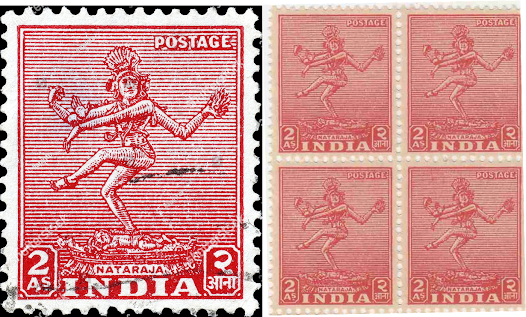
The enduring spell of the Tiruvalangadu Nataraja was cast worldwide. Museums across the world could not help but compare their own bronzes with the “famous example in the Madras Museum”. Cleveland museum, for instance, in 1930, took pride that its own Nataraja “fails by only three and a half centimetres” when compared with the Madras icon. Newspapers, as The Hindu did in 1941, featured the Tiruvalangadu bronze as one of the world's most delightful bronzes. The Indian postal department was not far behind. When it decided to publish a definitive series of 16 stamps focusing on Indian heritage in 1949, the Tiruvalangadu icon was a natural choice.
In many ways, the exhaustive account given in 1974 of Nataraja in art and literature by C.Sivaramamurti, the reputed art historian, firmed up the significance of this sculptural form and summed up its renown. In Sivaramamurti's list, too, the Tiruvalangadu bronze found a special place. After analysing hundreds of sculptures, he concluded that it was “the best known image of its kind in any public museum”. The journey came a full circle in 1992 when the Madras museum published a brief catalogue of its select bronzes. The Velankanni bronze was left out, but Tiruvalangadu Nataraja adorned the cover, and was prominently included in the catalogue.

Well!  With this my story should end - on a glorious note!
But there's a twist...

The true significance of my Nataraja...
My moment of epiphany came just last month - when I attended a series of lectures on Chola Bronzes by Vijayakumar (of the Idol Thief fame).

Vijayakumar said that all Bronzes are called  திருமேனிகள் for a specific reason. They were commissioned, conceived and executed as Representations of God, meant to be housed in Temples and nurtured with all the rituals as prescribed in the Agamas, which is what endowed them with their aura, presence and vibration.
They were to be approached as GODS, with an inherent feeling of spirituality.
To view them as mere objects of art amounted to a sacrilege and showed great disrespect to both the creativity of the sculptor and the intent of the creation.

With this in mind, I visited my Nataraja again. Having read Gopu, I also had a new term for his smile 'சிறுமுறுவல் வந்தெனது சிந்தை வௌவ' - seemed to clearly describe the impact of his smile on me. (This phrase is from Appar's Thevaram on the Shiva from the Valampuram temple, which was referenced by Dr. Nagaswamy in his book Oviyapavai and which in turn inspired Gopu!)

Standing before him, I finally understood, what it was, that he had been trying to tell me for over 10 years. He was damaged (the Framework that defined him and gave him stability had gone). He was displaced. His identity reduced to a 2 line plaque at his feet. 99.99% people who visited him, passed him along with nary a 2nd thought.

Yet HE WAS. And CHOSE TO BE. Complete, beautiful, at peace and full of equanimous joy. Accepting Himself and His audience for what they were.

Is this not how we should be? Accepting ourselves with all our seeming flaws and incompletion, finding our own Home & identity, no matter where we are placed and above all finding Equanimous joy, every moment of our lives! I truly felt blessed & what began almost 10 years ago as a clueless quest found its culmination at last!

A small error rectified - as pointed out by my friend Vallabha.
The oldest Nataraja Sculpture (present as of today) is at Asanapet Odisha (and not Seeyamangalam).


Belonging to a date around 4th century CE,
The Asanapat Nataraja has a 13 line inscription below, in Sanskrit Language with Post Brahmi or early Kalinga script.

It describes the achievements of  King Satrubhanja  as a conqueror and spiritual man.  
 

Monday, April 22, 2024

Paintings of Ajanta #3 - Mahajanaka Jataka

It was suggested by Prof. Swaminathan, that for a clearer understanding of my earlier Post #2, I should do a detailed step by step explanation of at least one panel, along with the Jataka story - to elucidate my points better.

Here I have attempted to do that with the Mahajanaka Jataka Tale in Cave 1. It is located on the left wall, in the centre, as a linear panel.
This is an important, yet fairly simple composition executed in the Baroque Style of Art.


Mahajanaka Jataka - Cave 1 - Schlingloff and the Net
The Story ...
Once upon a time, in Mithila, in the Kingdom of Videha, there was a king Mahajanaka, who had 2 sons - Aritthajanaka and Polajanaka. After his demise, Polajanaka went to war with his brother, defeated him and killed him. 
Aritthajanaka's queen, in exile, gave birth to a son named Mahajanaka, who was no less than a Bodhisattva himself. He went all over the world, as a merchant, amassed enough wealth and regained his father's kingdom.
Meanwhile Polajanaka died, leaving behind, his beautiful daughter Shivali. 3 difficult conditions had to be fulfilled by anyone wanting to marry her. Mahajanaka fulfilled all the 3, married her and lived happily, ruling from Mithila.

But he soon grew tired of all the luxury and material comfort of the palace life and wanted to renounce this and lead an ascetic life. 
When he mentioned this to Shivali, she first refused to accept this and tried to entice and seduce her king with music, dance and then her own self.
But the King's heart was not in any of these. He left the palace to go and meet an ascetic/ teacher who preached to him about salvation and solitude.
Convinced, the King returned to the palace, informed his queen and subjects about his decision and finally left the palace with great fanfare to proceed towards an abode of his calling, to meditate and attain wisdom.

The Painting/Panel ...
Essentially painted above the lintel, the Painting has 7 scenes - each of which, I have tried to explain in detail.
The Painting only concentrates on the main tale of the Bodhisattva and his renunciation. His past is not illustrated.
The Overall Panel - with Individual scenes marked out.
The Painting can be broadly divided into 7 scenes
1.   Looking at some women preparing cotton, the King gets his idea of wanting to live alone.
2.   The King tells the Queen about his decision, but she tries her best to seduce and beseech him. 
3.   She also arranges for a music and dance performance to entice him & divert his attention.
4.   Unmoved, the King leaves the palace to go and meet an ascetic and seek advice.
4a. He is accompanied by warriors, standard bearers and minstrels.
5.   Along with his retinue, the King listens to the sermon of the master.
6.   Returning to the palace, the King informs the Queen about his decision.
7.   After convincing her, he leaves the palace one last time, with all fanfare, accompanied by his subjects.
 
Use of Architectural Elements 
Like all paintings in Ajanta - within a large panel, there is no conventional separation/ fragmentation of scenes using Frames.
Instead Architectural elements are used to act as unobtrusive dividers that allow for seamless blending of individual scenes into an overall composition that follows all the basic rules of art like balance, harmony, focus etc.

Further these elements are used to
-  Highlight a focal activity from its surroundings by showing it inside a Pavilion
-  As backdrops for certain scenes and spaces like Palace Courtyards (Pavilions and building facades)
-  Highlight transitions both physically and metaphorically (Palace Gates)
-  Represent not just a physical space, but a social milieu.
Thus buildings and their elements are intrinsic and integral to the painting.

Scene 1 ...
Scene 1 - Me and Schlingloff
Here the King is supposed to be having his moment of epiphany by seeing women working on cotton preparation.
One woman is wearing 2 bangles, which clash together and resound, while the solitary bangle on the other woman remains silent.
His decision to seek solitude emerges thus.

-  The women are shown inside a Pavilion - thus making them a focus while the King is outside observing.
-  It also helps to demarcate a scene seemingly inconsequential at one corner of the Panel.
-  A series of steps are used to connect this Pavilion to the next one - showing a sequence of Activities and moving the story forward.
- The simple design of Pavilion also indicates a humble surrounding.

-  The Women are grouped together - at work.
-  Their sensuous body language and grace and rhythm are typical of all Women portrayals.
-  Simply adorned with minimal jewelry and flowers in their hair.

Scene 2 ...
Scene 2 - Schlingloff and me.
The King tells the Queen about his decision, while they are surrounded by her retinue.
She is heartbroken, beseeches him and tries to entice him.

-   Once again the Pavilion is used to create a focus for the central activity. The 4th wall is broken and you are gazing straight at the King and the Queen.
-   All secondary participants/ onlookers are kept outside the Pavilion.
-  The outermost pillar of the Pavilion helps to demarcate and contain the scene.
-  The Ornate and elaborate design of the Pavilion indicates the royal stature of its occupants.
-  Buildings grouped as a facade at the back - indicate the location as a palace courtyard.

-  The King is portrayed with complete regalia, jewelry and ornamental crown. His expression captures his confusion, dilemma and disinterest. He has no eye contact with the Queen.
-  The individual and overlapping portrayal of the women is a signature style of Ajanta.
Scene 2 - Benoy Behl and ASI.
- Shivali is leaning into the King in a sensuous, intimate way - her entire being suggestive of seduction and surrender at the same time.
- Her face portrays her grief, anxiety and concern as she tries to catch the eye of the King, who is not really looking at her.
- The other women, languid in their poses are variously leaning, standing, sitting or squatting.
- Most of their expressions convey anxiety and concern, while their hands indicate request/ pleading 
- A couple of women (including one pressing the Queen's feet) is looking the other way, creating a continuity with the next scene.

Scene 3 ...
Scene 3 - ASI and Benoy Behl
The Queen arranges a programme of Dance and music to entertain the King and try to engage him afresh in the sensual and artistic pursuits available to him in the palace.

-  Here the Pavilion with a unique design and distorted/ reverse perspective is used as a backdrop to highlight the principal dancer and her retinue.
-  A stand alone pillar with a couple of women around establishes spatial continuity and sequence of activity with the previous scene.
- Overall detailing indicates a palatial setting.

-  The Women portrayed here, are some of the most beautiful and graceful in Ajanta.
-  They are all mostly clothed in a variety of fabrics and adorned in simple jewelry and flowers.
-  Though they are varied in their postures, they uniformly convey fluidity, motion, rhythm and grace.
-  This is among the fewer scenes (in Ajanta) filled with the joy and festivities, as celebrated in the society, then.

Scene 4 and 4a...
Scene 4 - Me and Schlingloff
Here, the King, unmoved by the Queen's pleas, leaves to meet an ascetic/ master to discuss his desired path.

The Palace Gate acts as a Transition point in the painting
-  Between 2 scenes
-  For the Act of leaving the palace and going outdoors
-  For showing the change in the Kings heart - of wanting to switch to a different life.
-  Since the scene is outdoors, presumably in a garden or jungle - no other building elements are seen.

-  The King is leaving on an elephant as though on a royal procession, complete with warriors with weapons.
-  His retinue, unaware of the scenario, are busy in their own acts. 

Scene 5...
Scene 5 - Schlingloff and Me
The King meets the Ascetic and listens to his sermon along with his entire retinue. He feels vindicated in his chosen path.

Since this scene is played out completely in the open (possibly in a jungle), there are no building elements here except
-  A pile of stones at the Ascetic's feet (in front of which a devotee is kneeling down), a pedestal of sorts, forming a continuity with the previous scene
-  Some buildings in the distance indicate the backdrop of a city far away.

-  The Ascetic, as he is the Teacher, is shown elevated - sitting on a Pedestal
-  The King, in a far simpler costume, jewelry and crown, is sitting humbly at his teacher's feet. His body language is one of surrender and humility with folded hands.
-  His retinue, some of them still on elephants, have surrounded the Master with rapt attention.
-  Even the animals, including the 2 deer at the Master's feet are focusing totally on him.

This is a scene where the power of sermonising & its ability to unite man & beast alike is clearly depicted.
The Ascetic and the King - Benoy Behl
Scene 6...
Scene 6 - Me and ASI
The King, having made up his mind, tells Shivali - his decision to abdicate and leave the palace.

-  Here the emphasis is on showing what all the King is leaving is behind. Hence he is not isolated inside a Pavilion. Instead, along with the Queen and her retinue, he is shown in front of an elaborate backdrop of ornate buildings (The Palace).
-  The focus is on the people and their reactions. There are no building elements in the scene - except structures in the foreground, at the bottom (again a distorted perspective) to show an enclosed courtyard, in the Palace.

-  There is a marked contrast (to Scene 2) in the way the King and Queen are portrayed. It is no longer an intimate scene. Hence too, the absence of a Pavilion enclosing them.
-  The King is serene, composed and clear. He has eye contact with the Queen and his posture is one of relaxed ease.
- The Queen sits away from him and stoic acceptance and dignity personify her.
-  Both are clothed differently than before, wearing less ornaments & simpler costumes.
- The women surrounding them are in various poses showing anger, anxiety, perplexity and mere curiosity. While some of them are focusing on the royal couple, a few are having their own conversations.

Scene 2 and Scene 6 - Difference in the Portrayal of the Royal Couple.

The King and the Queen - Benoy Behl and ASI

The Women (The Varied Expressions) - Benoy Behl and ASI

Scene 7...
Scene 7 - ASI and Benoy Behl
The King leaves the palace, to realise his calling as a Bodhisattva.
His departure is in full regal splendour amidst fan fare and his loyal subjects.

Once again, a Palace Gate is used as a Transition device to show
-  The Physical exit of the King from the palace to the outside world
-  His metaphoric transfer from a life of luxury & comfort to one of ascetism and self realisation.

-  The King has a serene expression and is riding a horse (Not an elephant because this is not a celebratory Royal Procession)
-  He is simply clothed though the crown is still there.
-  His subjects include a variety of musicians, including a conch blower, a cymbal player and a percussionist. (Perhaps it was a custom to give people a musical send off)
-  People also show expressions of acceptance. No one is shown anxious or grieving.

Mahajanaka Jataka is one of the simpler panels at Ajanta, with straightforward sequencing and scenes of narration. Also most of it is intact and identifiable.
The locations of activities are few (The palace and the jungle and the path in between).
The no of scenes are also minimal with each scene having a specific focus and clearly linked to the previous and next scenes.
The principal characters are few (King, Queen and Ascetic). Rest are just the retinue and onlookers, who add to the denseness and detailing of the scenes.

Yet, this panel offers excellent scope for studying both the portrayal of people and usage of Architectural elements to convey a complete story, in its physical and social context.
The individual panels blend seamlessly, yet retain their identity.
Indoor and outdoor spaces are equally well detailed, giving us a glimpse into the type of structures and life styles that existed then.
As always in Ajanta, each and every person is detailed fully, including his/her body language and facial expression.
Thus society, as a whole is portrayed and you realise, the various sections of society intermingled freely and participated in each others lives and man and beast co-existed in harmony.

As mentioned by Prof. Swaminathan - 'This is only a drop from the Ocean of Ajanta Art!'

Several of the other paintings in Ajanta are far more complicated.
But they can be understood and appreciated on the same basis by first knowing the jataka tale completely and then identifying the scenes based on the markers used.
Professional photographs / sketches further help us to understand the detailing and techniques of drawing, painting and perspective.

Radhika: The Gentle Mirror

I n memory of my close friend Radhika, who left us so suddenly, in the first week of this year.  It has taken me almost 7 months to build up...